
Carrier HVAC Review 2026: Models, Warranty & Verdict
Carrier is the original air-conditioning manufacturer (Willis Carrier, 1902) and the premium-tier benchmark in residential HVAC. UTC spin-off April 2020. Sister brand Bryant uses the same factories at -10–15% pricing.
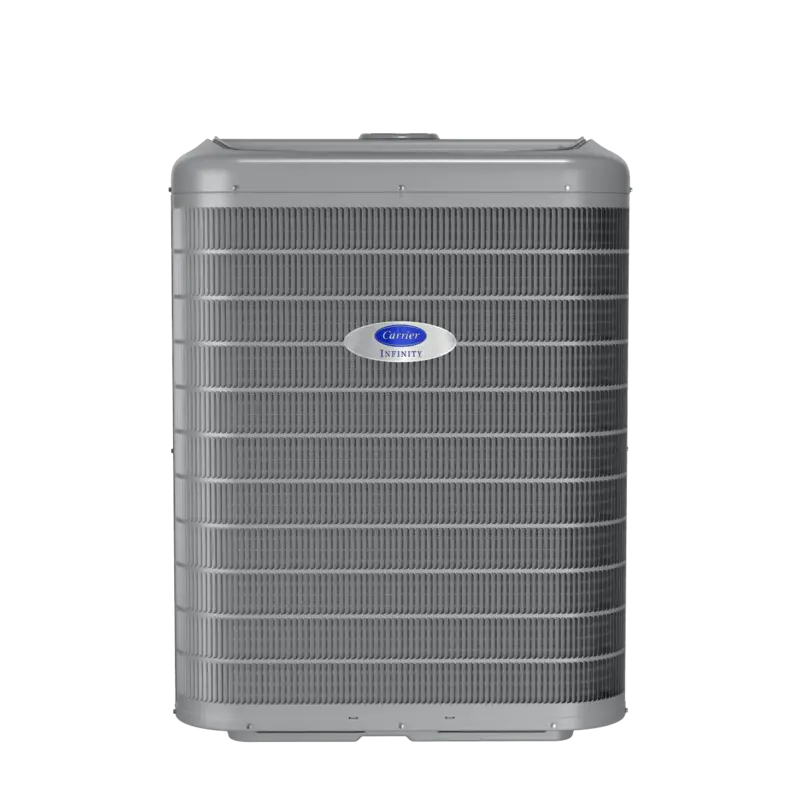
Brand facts
- Founded
- 1915
- Headquarters
- Palm Beach Gardens, Florida, USA
- Parent company
- Carrier Global Corporation (NYSE: CARR)
- Website
- Official site
Pros
- Only major brand with full R-454B transition completed (May 2026)
- 90-day warranty registration window (vs 60 days at Lennox, Trane, Goodman)
- Consumer Choice: 5-year parts + 3-year labor option available
- Lifetime heat exchanger warranty on registered Infinity 59MN7 furnace
- U.S. News “Best HVAC Company” 2024 and 2025
- Factory Authorized Dealer network with stricter install standards
- Mini-split `38MPRB` reaches 28.5 SEER2
Cons
- Flagship `26VNA1` tops at 21.0 SEER2 — trails Lennox (26.0) and Goodman (22.5)
- No published MSRP — all pricing through dealer contact
- R-454B cylinder costs $700–$2,000 per 20-lb (higher than R-32 service costs)
- 2020 ductless recall (fire hazard, 5,350 US units)
- Bryant sells identical hardware 10–15% cheaper
- CR predicted reliability 4/5 — trails Trane at 5/5
- New residential construction installs excluded from Consumer Choice warranty
Carrier earns the premium for buyers in hot or humid climates planning to stay 10 or more years. The full R-454B transition, the 90-day registration window, the Consumer Choice labor option, the lifetime furnace heat exchanger on registered Infinity furnaces, and the Factory Authorized Dealer network combine into a measurably stronger ownership package than value-tier brands. The Consumer Reports reliability rating (4/5 predicted, 5/5 owner satisfaction) and the U.S. News “Best HVAC Company” award two years running support the premium positioning.
The case against is also clear. Lennox’s R-454B SL25KCV hits 26.0 SEER2 against Carrier’s 21.0 — five points of efficiency on the table for peak-rating buyers. Goodman’s R-32 ecosystem is cheaper to service and 20–30 percent cheaper to install. Bryant gives you identical Carrier hardware at 10–15 percent less. Trane has slightly better reliability data and the Spine Fin coil for coastal use.
Rating: 4.2/5. The brand belongs on every homeowner’s short list in 2026. It does not deserve a default win.
This review is built on Carrier’s own product pages, published warranty terms, the AHRI Directory, CPSC recall filings, three pricing aggregators, and two HVAC technician forums. Where Carrier did not publish a number, we say so. Where we could not verify a claim, we removed it.
Who should buy Carrier — and who should look elsewhere
Three buyer profiles get the most from Carrier. The long-stay owner in a hot or mixed climate (IECC zones 1–4) recovers the refrigerant-currency premium over a 12–18-year ownership window. The multi-zone retrofit buyer benefits from Carrier’s communicating Infinity control architecture, which manages variable compressor speed and humidity across three zones without third-party zoning panels. The coastal homeowner gets a hardened outdoor coil option on Performance and Infinity tiers without stepping up to specialty SKUs.
Three buyer profiles should look elsewhere. Short-stay owners (under seven years to next move) cannot recover the install premium against Goodman or Rheem. Tight-budget replacements where the existing ductwork and furnace work fine get more cooling per dollar from Bryant — the same factory, the same hardware, 10–15 percent less money. Buyers chasing the absolute SEER2 number for R-454B should look at Lennox SL25KCV at 26.0 SEER2.
Carrier’s 2026 residential lineup
Carrier publishes 5 central AC platforms, 12 heat pump variants, 22 gas furnace models, and 6 ductless mini-split families. Every active central AC SKU ships on R-454B (Carrier brand name: Puron Advance). The Infinity tier uses variable-speed compressors with Greenspeed Intelligence; Performance is two-stage or single-stage; Comfort is single-stage. All five central models we verified appear on carrier.com with current spec sheets.
Central air conditioners
| Series | Model | Compressor | Max SEER2 | Max EER2 | Sound floor | Refrigerant |
|---|---|---|---|---|---|---|
| Infinity® 21 | 26VNA1 |
Variable-speed (Greenspeed) | 21.0 | not published | not published | R-454B |
| Performance™ 18 | 26TPA8 |
Two-stage | 18.0 | 14.0 | 67 dBA | R-454B |
| Performance™ 16 | 26SPA6 |
Single-stage | 16.5 | 14.5 | 67 dBA | R-454B |
| Comfort™ 16 | 26SCA5 |
Single-stage | 16.5 (range 13.8–17.0) | 14.5 (range 11.2–14.5) | not published | R-454B |
| Comfort™ 14 | 26SCA4 |
Single-stage | 16.0 (variant 26SCA524: 14.3–16.0) | 13.5 | not published | R-454B |
Two coastal variants exist: 26TPA8***C (Performance 18 Coastal) and 26SCA5***C (Comfort 16 Coastal). Both ship with hardened cabinetry for salt-air installs in the Carolinas, Florida, and the Gulf — no separate premium SKU required.
Heat pumps
The Infinity 23 (27VNA3) heat pump reaches 23 SEER2 and 10 HSPF2 with Greenspeed Intelligence. The cold-climate 27VNA1 Infinity 21 Ultimate is rated at 21.2 SEER2, 13.5 EER2, and 10.5 HSPF2 per Carrier’s heat pump benchmark press release — Carrier characterizes it as the highest-rated DOE Cold Climate Heat Pump on the market. Performance and Comfort heat pump variants mirror the central AC tier structure.
Gas furnaces
The Infinity 59MN7 modulating gas furnace tops the lineup at up to 98.5% AFUE, modulates in 1-percent increments, and carries Carrier’s variable-speed blower. It also gets a lifetime heat exchanger warranty when registered (20 years if unregistered) — the strongest warranty term in Carrier’s residential portfolio. The Comfort 59SC6 sits at 95 AFUE for buyers who don’t need modulation.
Mini-split: the underrated story
Carrier’s Infinity mini-split 38MPRB hits 28.5 SEER2 and 18 HSPF2 in single-zone configuration. That is higher than the central AC flagship — 28.5 versus 21.0 SEER2. The mini-split lineup also includes 38MARB (single-zone, 28.1 SEER2), 38MGRB and 38MGHB multi-zone systems (up to 26 SEER2), and the 38MGR inverter multi-zone. For context, Mitsubishi’s MSZ-FS06NA mini-split hits 32.2 SEER2 in the 6,000 BTU size — currently the highest residential SEER2 we have verified across any brand. Carrier’s mini-split lineup is competitive but does not lead the ductless category.
Pricing by tonnage: what the aggregators show
PICKHVAC published Carrier installed-cost ranges on June 21, 2025. Those numbers are below. Carrier does not publish MSRP — its prices page states only that “the best way to get accurate pricing is to contact your local Carrier dealer.”
| Tonnage | Unit only | Installed (national avg) |
|---|---|---|
| 2 ton (24,000 BTU) | $2,800–$4,400 | $3,900–$5,900 |
| 3 ton (36,000 BTU) | $3,300–$5,200 | $4,500–$7,300 |
| 4 ton (48,000 BTU) | $4,000–$6,600 | $5,400–$8,400 |
| 5 ton (60,000 BTU) | $4,700–$7,700 | $5,900–$9,600 |
Three caveats. PICKHVAC does not publish 1.5-ton, 2.5-ton, or 3.5-ton figures, so the half-sizes most homes actually need are interpolations. HomeGuide reports a wider total install range of $3,000–$15,000. Modernize lists $4,600–$8,000 for the unit alone with installs reaching $10,000-plus. The spread comes mostly from regional labor rates and ductwork modification costs, not from the equipment itself.
Carrier’s installed-cost band sits within 2 percent of Trane’s. PICKHVAC reports a 3-ton Trane install at $4,580–$7,160 versus Carrier’s $4,500–$7,300. The brands are functionally tied on price at equal tier. The real pricing question is whether you should buy Bryant instead — see the comparison section below.
Video: Carrier Good, Better, BEST Review · Atlas AC
Efficiency and performance
SEER2 ratings: what Carrier publishes (and what it doesn’t)
Carrier does not publish per-model SEER2 figures on its lineup landing pages. The numbers above came from individual model pages, Carrier Enterprise distributor listings, and Carrier’s own product data PDFs. The series number — Infinity 21, Performance 18, Comfort 16 — loosely correlates with peak SEER2 but is not a guarantee. The 26SCA5 Comfort 16, for example, actually spans 13.8 to 17.0 SEER2 depending on tonnage and coil pairing.
For verification: pull the AHRI Reference Number for the exact outdoor-plus-indoor combination from your installer. AHRI lists certified matched-system ratings. The AHRI number lives on the tax credit and ENERGY STAR documentation an installer hands you. If the installer cannot produce it, push back.
Refrigerant transition: Carrier finished first, but at what cost?
Federal AIM Act rules required HVAC manufacturers to stop producing new R-410A units after January 1, 2025. R-410A units must be installed by January 1, 2026. Every brand had to pick a replacement refrigerant. Carrier picked R-454B (brand name “Puron Advance”) and completed transition on all current residential AC models.
Two competing refrigerants split the industry. The R-454B camp includes Carrier, Bryant, Lennox (partial — flagship still R-410A), Trane (partial — XV20i/XR16 still R-410A May 2026), Rheem, York (post-Bosch acquisition), and Mitsubishi (METUS launched R-454B Apr 17, 2025). The R-32 camp is Daikin, Goodman, and Amana — all under Daikin Comfort Technologies North America. The two refrigerants are not interchangeable. Service parts, refrigerant supply lines, and contractor familiarity do not cross over.
The 2026 cost reality on R-454B is harsher than the brochures suggest. Aftermarket R-454B cylinders ran $700–$2,000 per 20-pound cylinder in early 2026 — up from $345 in 2021 — with Honeywell adding a 42 percent surcharge on the refrigerant earlier this year. A typical residential leak repair takes 2–6 pounds of refrigerant. The same repair on R-32 is materially cheaper because R-32 is a single-component refrigerant (R-454B is a blend), simpler to handle, and not subject to the same supply-chain shock.
Technicians on /r/HVAC and HVAC-Talk currently report a preference for R-32 systems on service economics. That preference does not mean R-454B is a bad refrigerant. It does mean total cost of ownership over a 15-year service life now favors Goodman, Daikin, and Amana on refrigerant supply — a fact buyers should know before paying the Carrier premium.
One additional industry-wide quirk: first-generation MOS leak sensors used on A2L refrigerants (both R-454B and R-32 are A2L, mildly flammable) cross-react with VOCs from spray foam insulation, paint, vinyl flooring, and even hairspray. The result is nuisance lockouts that look like refrigerant leaks but aren’t. This is not a Carrier problem specifically — it is an industry-wide A2L sensor calibration issue — but a new Carrier homeowner should know it exists.
Carrier warranty: the Consumer Choice program decoded
Carrier’s residential warranty is structured around a choice the homeowner makes during the first 90 days after installation. Register on time and pick one of two options: 10-year parts-only, or 5-year parts plus 3-year labor (labor option only if the installing dealer participates in the Consumer Choice program). Miss the 90-day window, and the warranty drops to a 5-year parts-only base with no labor coverage.
The verbatim Carrier text from the company’s warranty page:
“The desired warranty option must be selected at the time of product registration, within the first 90 days after installation.”
“You can change your Consumer Choice warranty option only within the first 90 days after installation.”
Three exclusions matter. New residential construction installs are not eligible — only existing-home replacements and additions. Some jurisdictions block conditional warranties, in which case Carrier automatically applies the 10-year parts term without requiring registration. California is the most likely such jurisdiction, but Carrier does not name it explicitly on the warranty page. Value-tier ductless systems get only 5-year parts regardless of registration.
The furnace warranty is materially stronger. The Infinity 59MN7 page lists a lifetime heat exchanger limited warranty for the registered original owner, dropping to 20 years if unregistered. That is the longest single-component warranty in the Carrier lineup and one of the longest residential furnace heat exchanger warranties on the US market.
What Consumer Choice does not cover: labor on parts-only terms, refrigerant during leak repair, and second-owner coverage at full term (the warranty transfers to a new homeowner once, within 90 days of property sale, at reduced terms).
Reliability and known issues
Three CPSC recalls touched Carrier residential equipment over the past decade. We pulled the entries from CPSC’s recall database.
| Year | Affected equipment | Scope | Hazard | Remedy |
|---|---|---|---|---|
| 2025 | Two-stage gas furnace / packaged units | Units sold Jan 2024–Mar 2025 at $8,250–$12,900 | Gas leak from ignition system; 1 incident, no injuries | Dealer replaces ignition board free |
| 2020 | Carrier+Bryant ductless heat pump outdoor units (1.5T, 4T multi, 4T single) | ~5,350 US + ~450 Canada, sold Mar 2015–Apr 2019 | Fire; 6 fire incidents reported | Free replacement |
| 2024 | Cross-brand packaged units (DCT NA: Daikin, Amana, Goodman + Bryant) | ~12,100 packaged units, sold Jan–Mar 2024 | Fire | Recall remedy per CPSC |
The 2020 ductless recall is the most relevant for current homeowners. It hit Carrier and Bryant simultaneously, which is consistent with shared manufacturing. The 2025 gas furnace recall involved 1 reported incident with no injuries — manageable scope.
On HVAC-Talk, a multi-page thread titled “5+ years of Carrier Infinity problems: do I fix it again or hop on a Trane?” documents repeat failures across valves, circuit boards, coils, and a compressor on one homeowner’s Infinity heat pump. A separate thread, “Carrier Infinity system - too high tech ??,” runs a debate between technicians on whether the Infinity control architecture is over-engineered or whether critics simply haven’t kept up with training. We treat both threads as sourced anecdotes — real complaints that exist, not statistical evidence of systemic failure rates.
One thread mentions a warranty denial: a contractor failed to file Carrier registration paperwork, and after five years of authorized warranty service, Carrier disavowed coverage. The lesson: verify registration yourself at carrier.com within 90 days. Do not trust the dealer to file it.
How Carrier compares to top alternatives
Carrier vs Bryant: same factory, different price
Carrier Global owns Bryant. The two brands share US manufacturing — including the Indianapolis plant — and residential lineups are 1:1 hardware pairs. The comparison table below shows the tier-level SKU pairs with both SEER2 ratings.
| Bryant tier | Carrier tier | Bryant model | Carrier model | Both SEER2 |
|---|---|---|---|---|
| Evolution™ | Infinity® | 191VAN |
26VNA1 |
21.0 |
| Preferred™ | Performance™ | 148TAN |
26TPA8 |
18.0 |
| Legacy™ | Comfort™ | 135SAN |
26SCA5 |
16.5 |
| Crossover/specialty | Crossover/specialty | 37MUHA, 37MURA, 33NM3 |
37MUHA, 37MURA, 33NM3 |
(identical model #) |
PICKHVAC pricing data shows a Bryant 3-ton install at $3,500–$6,500 versus Carrier’s $4,500–$7,300. The Bryant gap runs roughly 10–15 percent across tonnages.
What you give up with Bryant: the Carrier Factory Authorized Dealer network has higher training and customer-satisfaction thresholds, and Bryant does not advertise the “5 years parts plus 3 years labor” Consumer Choice option that Carrier offers. Bryant’s warranty page lists the 10-year parts term with the same 90-day registration window, but the parts-plus-labor split appears to be a Carrier-channel program. Verify this with any Bryant dealer in writing before purchase.
The buying logic: if your local Carrier FAD quotes $11,500 for a 3-ton Performance 17 install and the local Bryant dealer quotes $9,800 for the equivalent Preferred unit, and both technicians are NATE-certified, you are getting Carrier-quality hardware at a 15 percent discount. Take the Bryant.
Carrier vs Trane, Lennox, and Goodman
The four-brand top tier of US residential HVAC is Carrier, Trane, Lennox, and Goodman. Each leads on a different dimension.
Trane wins on reliability perception and corrosion resistance. Consumer Reports puts Trane at 5/5 predicted reliability versus Carrier at 4/5 (both 5/5 owner satisfaction, per the Airco Mechanical 2025 recap). Trane’s all-aluminum Spine Fin coil is patented and rated for 2,000-hour salt spray exposure — twice the industry standard of 1,000 hours. Trane also won the “America’s Most Trusted HVAC Brand” Lifestory Research award for 12 consecutive years as of January 2026 (the figure was 10 years in 2024). On warranty, Trane requires 60-day registration versus Carrier’s 90. On refrigerant transition, Trane is behind: the XV20i and XR16 product pages still list R-410A in May 2026.
Lennox wins on peak efficiency. The R-454B SL25KCV hits 26.0 SEER2, the highest R-454B central AC rating we verified. The discontinued R-410A SL28XCV reaches 25.80 SEER2 (the “28” in the model number refers to legacy SEER, not SEER2). Lennox’s warranty terms are tighter than Carrier’s — 60-day registration with no Consumer Choice labor option in the Signature tier — and Lennox has the Thomas v. Lennox formicary corrosion class-action history on evaporator coils ($550 reimbursement, settled and fixed with the Quantum coil design). The 2020 CPSC ductless heat pump fire-hazard recall hit Lennox along with Carrier and Bryant.
Goodman wins on price and warranty marketing. Goodman is owned by Daikin (acquired August 2012 for $3.7 billion; US sub renamed Daikin Comfort Technologies North America in April 2022). The Goodman flagship GSXV9 hits 22.5 SEER2 — higher than Carrier’s 21.0. Goodman’s headline warranty is a 10-year unit replacement on select models when registered within 60 days, plus a lifetime compressor for select higher-efficiency models. Goodman pricing typically runs 20–30 percent below Carrier installed. The catch: Goodman uses R-32 refrigerant, not R-454B, putting it in a different service-parts ecosystem.
| Brand | Flagship SEER2 | Refrigerant (flagship) | Registration window | CR predicted reliability | 3-ton install (PICKHVAC) |
|---|---|---|---|---|---|
| Carrier | 21.0 (26VNA1) |
R-454B | 90 days | 4/5 | $4,500–$7,300 |
| Trane | not published cleanly | mixed (XV20i still R-410A May 2026) | 60 days | 5/5 | $4,580–$7,160 |
| Lennox | 26.0 (SL25KCV) |
R-454B (flagship SL28XCV still R-410A) | 60 days | not published cleanly | not published cleanly |
| Goodman | 22.5 (GSXV9) |
R-32 | 60 days | below top tier | ~20–30% below Carrier |
The summary: Carrier is the only one of the four with both 90-day registration and full R-454B transition. Lennox owns peak SEER2. Trane owns reliability and corrosion resistance. Goodman owns price and warranty marketing.
Rebates, incentives, and total cost
Federal 25C tax credit: terminated
The federal Section 25C Energy Efficient Home Improvement Credit terminated December 31, 2025, under the One Big Beautiful Bill Act (Public Law 119-21, signed July 4, 2025). For 2026 installations, no federal credit is available. Installations completed on or before December 31, 2025, can still be claimed on the 2025 tax return filed during the 2026 tax season. Do not rely on aggregator sites still marketing 25C as active for 2026 — verify against the IRS directly.
HEAR (HEEHRA) state rebates
The HEAR (High-Efficiency Electric Home Rebate Act) program is live in 15 states as of May 2026: NM, WI, NY, RI, MA, NC, GA, MI, MD, IN, IL, CO, WA, ME, and AZ. Not yet launched: TX, FL, OH, VA, MN. California is waitlisted as of February 2026.
Income eligibility determines rebate size. Households at or below 80% of Area Median Income (AMI) qualify for up to 100% of costs; 80–150% AMI qualifies for 50%. Above 150% AMI: not eligible for HEAR. The HVAC rebate cap for heat pumps is $8,000 per household (lifetime cap $14,000 including other upgrades). Lookup your AMI at huduser.gov.
Buyers in states without an active HEAR program should check utility-level rebates — many utilities offer $300–$1,500 for qualifying heat pump installs independent of state programs.
How to buy a Carrier system: the five decisions you make
The Carrier purchase is not a single decision. It is five.
1. Get a Manual J load calculation, not a tonnage estimate
Most homes are oversized. Your existing 4-ton unit was probably wrong when it was installed. A correctly sized 3-ton unit dehumidifies better than an oversized 4-ton, runs longer cycles, and saves energy. ACCA Manual J is the residential load calculation standard — Energy Star certified installs require it. If your installer skips Manual J, do not sign.
2. Pick the tier honestly
Comfort 14 (26SCA4) for mild climates and tight budgets at 16 SEER2 max. Performance 16 (26SPA6) for the value sweet spot at 16.5 SEER2. Performance 18 (26TPA8) for two-stage humidity control in hot-humid climates at 18 SEER2. Infinity 21 (26VNA1) for variable-speed efficiency at 21 SEER2 — recover the premium only on 10-plus year ownership in hot climates.
3. Get three Factory Authorized Dealer quotes
Use carrier.com to filter to FAD status in your ZIP code. Independent contractors who carry the Carrier brand without FAD status give you the equipment without the install-quality guarantee. Get itemized quotes from at least three FADs: equipment, labor, refrigerant, electrical, permit, disposal of old unit broken out separately. Bundled all-in quotes hide pricing variance.
We did not find Carrier publishing specific FAD criteria — minimum insurance, NATE certifications by sub-discipline, audit cadence — on the public-facing FAD information page. Industry sources cite NATE certification and insurance minimums, but we cannot verify either against a Carrier source. Use FAD status as a quality screen, then get itemized quotes from at least three FADs before signing.
4. Compare against Bryant in your local market
Pull two Bryant dealer quotes for the equivalent Evolution tier (Infinity↔Evolution, Performance↔Preferred, Comfort↔Legacy). Bryant typically runs 10–15 percent cheaper for identical hardware. If your local Bryant dealer is NATE-certified, the math usually favors Bryant.
5. Register within 90 days at carrier.com
The 90-day registration window starts the day the unit is energized, not the day the contract is signed. Calendar it. Without registration, your 10-year warranty drops to 5 years. Without registration, the lifetime heat exchanger on a 59MN7 furnace drops to 20 years. Do it yourself the day the unit is energized.
Company background and ownership
Carrier Global Corporation (NYSE: CARR) became a standalone public company in April 2020 when United Technologies spun off its HVAC and refrigeration divisions. Headquarters: Palm Beach Gardens, Florida.
The company traces its origins to Willis Haviland Carrier’s 1902 patent for mechanical air conditioning. Carrier Engineering Corporation was founded in 1915 and became part of United Technologies in 1979 before the 2020 spin-off.
Two corporate facts shape what you buy today. Carrier Global owns Bryant — the two brands share US manufacturing facilities including a major plant in Indianapolis, and their residential lineups are 1:1 hardware pairs. The post-spin company has directed R&D specifically at the Infinity series, shipping the 26VNA1 inverter and the Infinity Touch control architecture after separation from UTC.
Refrigerant camp: R-454B. All current residential Carrier AC models ship on R-454B (Puron Advance). Carrier completed the transition ahead of Lennox and Trane, both of which still had R-410A flagship models on sale in May 2026.
No notable M&A since 2020. Carrier divested its commercial fire and security segment in 2021 and sold its Chubb fire and security operations. On the residential HVAC side, the ownership structure is unchanged: Carrier Global → Carrier residential brand + Bryant brand, manufactured in the US.
Frequently asked questions
Yes. Consumer Reports rates Carrier at 4/5 predicted reliability and 5/5 owner satisfaction (per third-party recap). Carrier won the U.S. News & World Report “Best HVAC Company” award in 2024 and 2025. The lineup is fully transitioned to R-454B refrigerant, ahead of Lennox and Trane. The trade-off is premium pricing 20–30 percent above value brands like Goodman.
The Infinity 21 (26VNA1) at 21.0 SEER2. That trails Lennox SL25KCV (26.0 SEER2) and Goodman GSXV9 (22.5 SEER2). Carrier’s mini-split flagship 38MPRB reaches 28.5 SEER2, higher than the central AC line.
Yes, but only if you register at carrier.com within 90 days of installation. Without registration, the warranty drops to 5 years parts only. You also pick either 10-year parts-only OR 5-year parts plus 3-year labor — not both. The 5+3 labor option requires that your installing dealer participates in the Consumer Choice program.
Functionally, yes. Carrier Global owns both. They share US manufacturing facilities including the Indianapolis plant, and residential lineups are 1:1 hardware pairs: Evolution↔Infinity, Preferred↔Performance, Legacy↔Comfort. Bryant typically retails 10–15 percent cheaper. The main differences are dealer network (Carrier Factory Authorized Dealers have stricter requirements) and the Consumer Choice labor warranty option (Carrier offers it, Bryant doesn’t advertise it).
R-454B, branded as “Puron Advance.” All current Carrier residential AC models ship on R-454B as of May 2026. R-454B is mildly flammable (A2L classification) and 78 percent lower global warming potential than R-410A. It is not a drop-in replacement for R-410A — R-454B outdoor units require matching indoor coils with dissipation systems.
No. The federal Section 25C Energy Efficient Home Improvement Credit terminated December 31, 2025, under the One Big Beautiful Bill Act. Installations completed on or before December 31, 2025, can still be claimed on the 2025 tax return filed during the 2026 tax season. For 2026 installs, look to state HEAR (HEEHRA) rebates where your state has launched the program — currently 15 states accept applications.
They are within 2 percent on installed cost (PICKHVAC: Carrier 3-ton $4,500–$7,300 vs Trane $4,580–$7,160). Trane has slightly better Consumer Reports reliability (5/5 vs 4/5) and the Spine Fin coil for coastal corrosion resistance. Carrier has the 90-day registration window (vs Trane’s 60), the Consumer Choice labor option, and full R-454B transition (Trane XV20i and XR16 product pages still list R-410A in May 2026). For most buyers, Carrier’s refrigerant currency outweighs Trane’s reliability edge. For Florida and Gulf Coast buyers, Trane’s Spine Fin coil tips the math.